Downtown Orlando’s Eola House Faces Possible Demolition as City Council Considers Local Landmark Designation
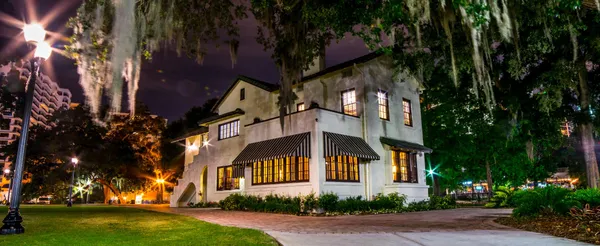
Decision point for a prominent Lake Eola structure
Orlando officials are preparing to consider whether Eola House, a historic residence on the edge of Lake Eola Park, should receive local historic landmark protection as demolition remains a possibility tied to future park expansion planning. City leaders are scheduled to take up the matter on Feb. 4, 2026, placing a long-standing preservation-versus-development question squarely before the city’s decision-making process.
The request centers on a landmark designation sought by a nonprofit organization. Landmark status can impose legal constraints on demolition and on major exterior alterations, shifting the property’s future from a planning question into a regulated preservation framework.
What Eola House is and how it is used today
Eola House sits at 512 East Washington Street, within Lake Eola Park. The building is used as a reservable public venue for meetings and small events, with the city listing hourly rental rates and a refundable damage deposit for different rooms and configurations.
Historical and architectural records identify the structure as a 1924 Mediterranean Revival home. Over time, it has become a recognizable feature of the park’s built environment, distinct from the surrounding open space and event lawns.
How landmarking works in Orlando
Orlando’s local landmark process runs through the city’s historic preservation system. Nominations are reviewed against established criteria that include historical associations, association with significant individuals, architectural distinction, and potential archaeological or historical information value. The process includes review by the Historic Preservation Board and ultimately requires City Council action through an ordinance that proceeds through two readings—one to accept and another to adopt—before a designation becomes official.
Separately, major changes to historic properties—explicitly including demolitions and landmark nominations—fall under the city’s “major review” track for historic preservation approvals.
Why the debate is emerging now
The timing intersects with broader planning for Lake Eola Park. The city has an established Lake Eola master planning framework intended to guide long-term updates to the park, and recent city discussions around park upgrades have highlighted the scale of anticipated capital work. Whether Eola House remains in place or is removed could influence design choices for circulation, programming space, and park facilities near East Washington Street.
Landmark approval could constrain demolition options and require preservation-oriented review for future changes.
Denial of landmark status would leave the structure more exposed to removal if future park expansion plans proceed in that direction.
The Feb. 4, 2026 meeting will determine whether Eola House is treated primarily as a historic resource or as a flexible site within a changing park footprint.
The upcoming City Council consideration is expected to clarify the city’s near-term direction for the property and, by extension, how Orlando balances historic preservation with evolving public-space needs in the downtown core.